



Introduction
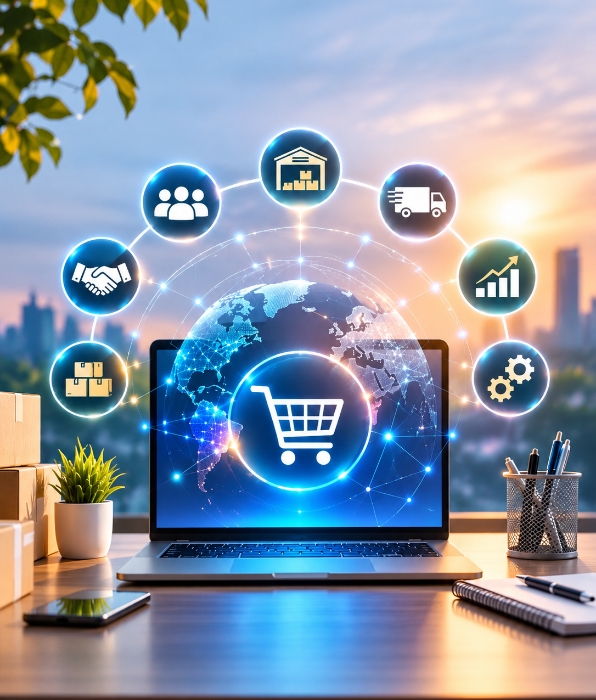
For decades, digital commerce has been about one thing: transactions on the internet.
Enterprises would build websites and e-commerce solutions for their goods to be seen, for orders to be placed, and for purchases to be easy and convenient. However, as enterprises get more complicated with their business networks, being able to conduct digital transactions is not enough.
From manufacturers to distributors to dealers to retailers and buyers, all of the different stakeholders could exist in different ecosystems. This makes it difficult for companies to have visibility and consistency in their communication and engagement.
It is at this point that Business Commerce, or B-Commerce, goes beyond transactions into ecosystems.

From Transactions to Relationships
Conventional e-commerce is frequently built around the customer and the transaction. A product is identified, chosen, and bought through an online channel.
Not so in B-Commerce.
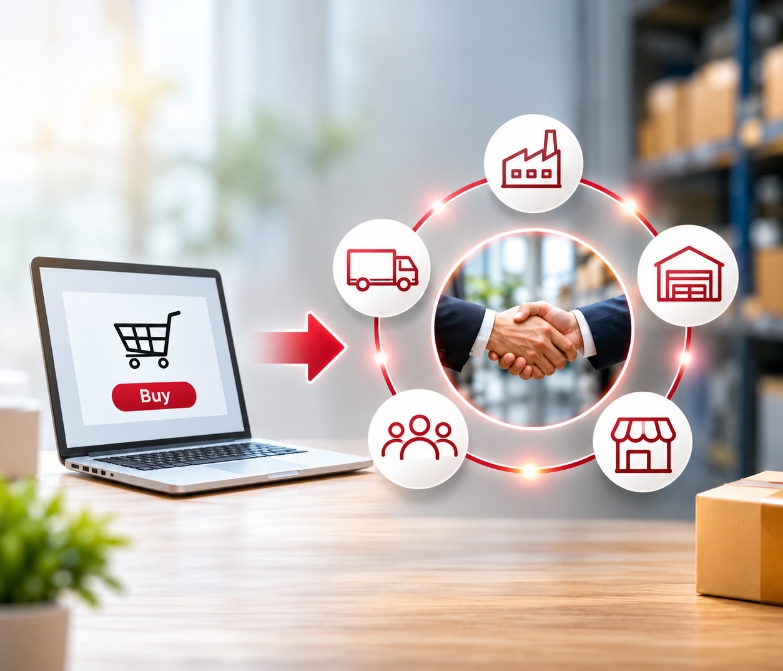
Instead of simply executing a transaction, B-Commerce works towards building up the processes and relationships that surround that transaction, which could be between manufacturer and distributor, distributor and dealer, dealer and retailer, or business and customer.
What sets Doodlezz apart from traditional e-commerce in the realm of B-Commerce is its ecosystem approach and relationship approach, enabled by adaptable business models, specialized business analytics and integration with ERP, CRM and APIs.
The transaction itself is still important – but becomes part of a bigger picture relationship.
What Makes a Connected Commerce Ecosystem?
A connected commerce ecosystem is one where various parties and processes get integrated in a digital environment.
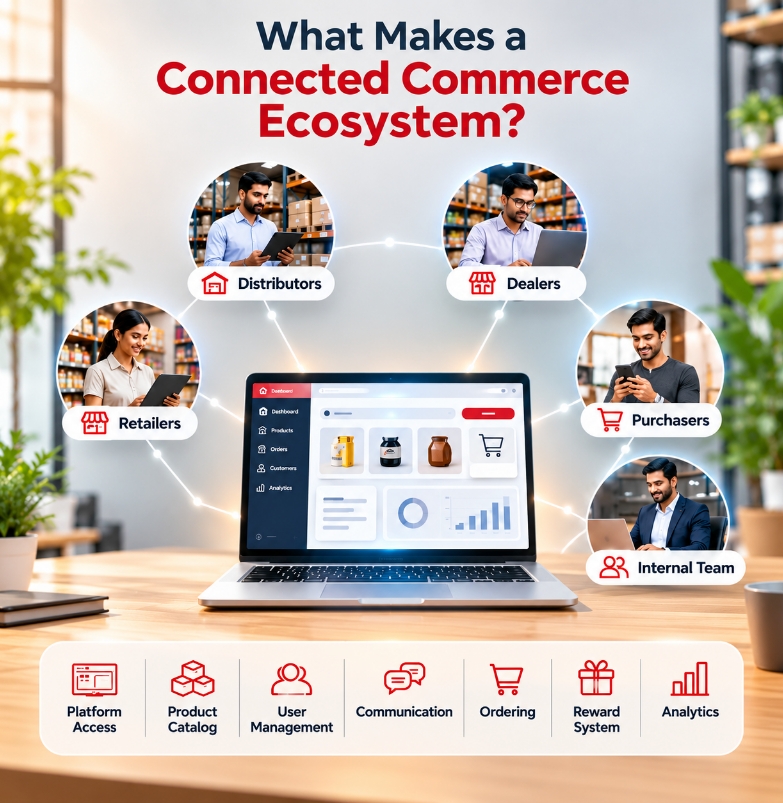
For instance, take the case of a firm that has many distributors. These distributors require access to information about the products; dealers need to place their orders, retailers need some information and also some motivation; and the firm's internal team needs information about its performance.
In case of interactions using disconnected tools, information gets scattered.
A connected ecosystem will be able to integrate platform access, product catalog, user management, communication, ordering, reward system, analytics, etc. In this way, there will be increased visibility, and stakeholders will be able to interact through processes created for their specific functions.
Doodlezz Business Commerce facilitates coordination between distributors, dealers, retailers, and purchasers, along with other platform operations.
Why Technology Alone Is Not Sufficient
The development of the technological platform is just one element of the successful creation of the commerce ecosystem.
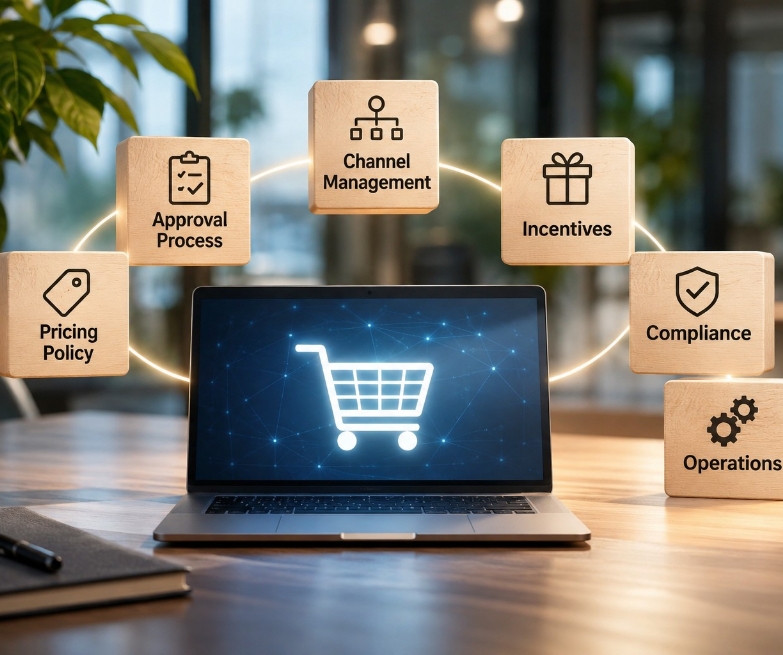
The platform must embody the business processes that underlie it. Businesses can vary in terms of their pricing policy, approval process, channel management, incentives, compliance, and operations.
That is why a generic platform may not always provide enough flexibility in order to deal with the intricacies of business network operations.
Doodlezz defines B-Commerce as a completely customizable and flexible business architecture with total control of enhancements, dynamic pricing according to business rules, and business-specific analytics.
Technology becomes much more useful when it revolves around business processes.
Connecting the Business Network
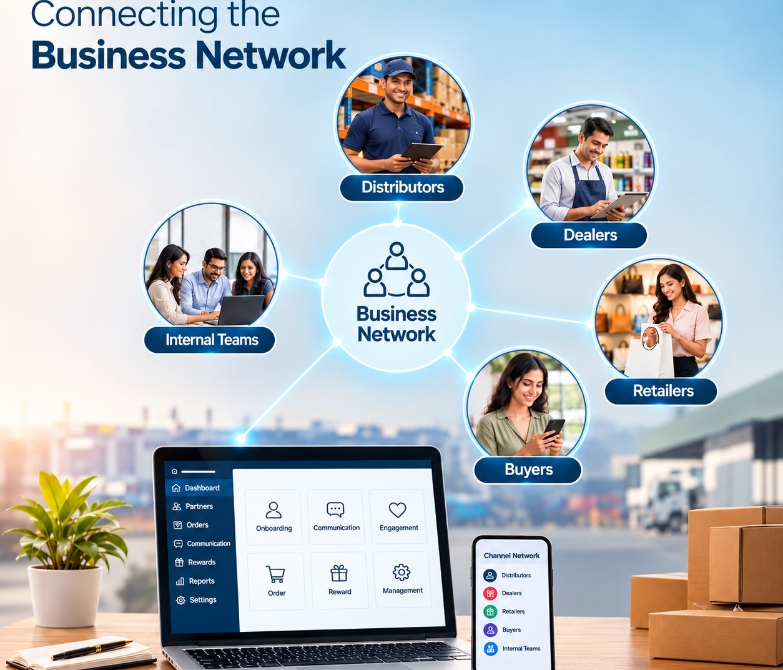
One of the greatest advantages of B-Commerce is connecting the different touchpoint stakeholders.
The distributors should be able to connect to the business process effectively. The dealers and retailers require relevant information and communication. Buyers require an improved purchase experience. Teams within the business network should be able to see activities within the network.
More than just a digital store is needed.
Connected workflows that support onboarding, communication, engagement, order, reward, and management processes are required.
Doodlezz helps channel partners connect through distributors, dealers, retailers, buyers, and internal teams, and provides communication and operational assistance for improving connectivity in channel networks.

What Businesses Need to Build a B-Commerce Ecosystem
There is also an opportunity presented by the connected ecosystem to convert operational data into business intelligence.
Data generation occurs in companies when there are orders, customer activities, channel activities, and many others. When this data is disjointed, pattern analysis becomes increasingly hard.
With connected analytics, a company gets better clarity of what is happening in its business.
The Doodlezz B-commerce Platform monitors performance data from operations and channel activities to assist businesses in analyzing their activities.
This shows that the target is not just to gather more data, but to ensure that this data becomes useful in making business decisions.
The Business Benefits of a Connected Ecosystem
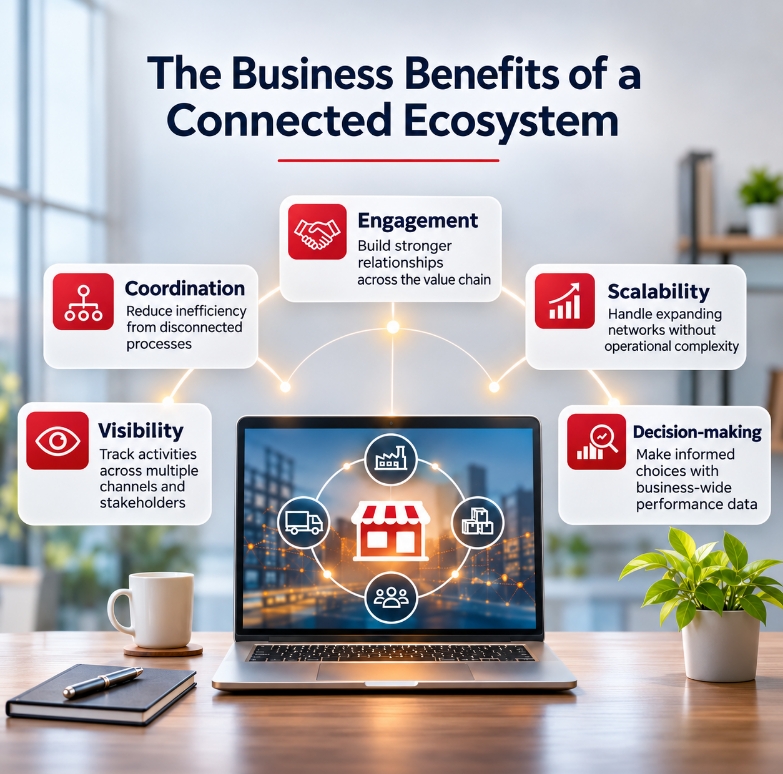
The process of transitioning towards a connected B-Commerce ecosystem has the potential to add value in several ways.
Visibility will allow companies to track activities across multiple channels and various stakeholders.
Coordination will decrease the inefficiency caused by disconnected processes.
Engagement will enable companies to build relationships with distributors, dealers, retailers, and buyers.
Scalability will allow companies to handle expanding networks without increasing operational difficulties.
Decision-making will be enhanced because performance information will be available in various areas of a business.
These business advantages are interdependent because good data can lead to improved decision-making, and better decision-making can help with improved operations.
Did You Know?
The 2026 Global B2B Pulse Survey by McKinsey shows that B2B buyers are using, on average, ten
different channels and
expect seamless transitions among them.
This is reflective of a growing trend in business commerce, whereby buyers and partners engage with businesses at several points along the way. Connected experiences become more relevant and essential compared to isolated digital channels.
What Businesses Need to Build a B-Commerce Ecosystem
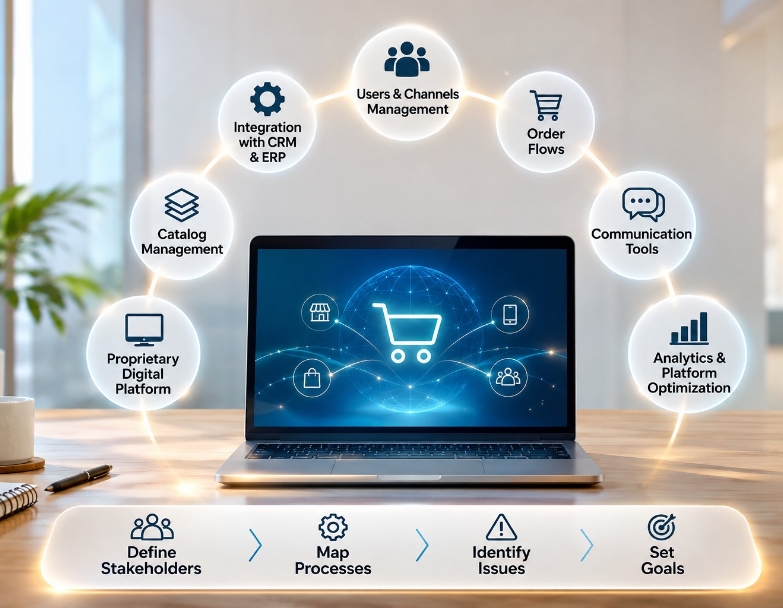
Creating a connected commerce ecosystem begins with getting to know your business before choosing any technology.
Businesses should be able to define their stakeholders, processes, issues, and goals, while the technology would be chosen according to these needs.
Components of such an ecosystem might include a proprietary digital platform, catalog management, integration with CRM and ERP systems, users and channels management, order flows, communication tools, analytics, and platform optimization.
The main thing here is that all these components have to work together rather than independently.
Did You Know?
The 2026 Global B2B Pulse Survey by McKinsey shows that B2B buyers are using, on average, ten
different channels and
expect seamless transitions among them.
This is reflective of a growing trend in business commerce, whereby buyers and partners engage with businesses at several points along the way. Connected experiences become more relevant and essential compared to isolated digital channels.
Conclusion
Business Commerce is evolving beyond the concept of moving business transaction processes online.
The next phase involves the creation of a connected system where various elements such as technology, operations, stakeholders, communication, and data come together. Not only does the platform serve as an ordering facility but also as a means by which the business manages its relationships and grows.
For businesses that have complex distribution systems and several stakeholders, a connected strategy may result in greater visibility and coordination and a good basis for growth.
Doodlezz combines platform design and development, channel partner management, order and growth management, analytics, marketing communication, and operational services to create Business Commerce ecosystems.

Krishna Talreja
Tech - Content writer
Nov 19, 2026
Why Doodlezz?

We are an integrated marketing partner that combines creative strategy with operational delivery, identity, guidelines, packaging, assets, and content built for both digital commerce and offline retail. Unlike boutique creative studios that stop at concepts, Doodlezz takes designs through production, vendor liaison, and campaign ready packaging, reducing launch friction. In the Oman India market, agencies often specialise in either creative or execution; Doodlezz’s end to end model positions it to reduce vendor hand-offs and accelerate time to market. Build a Brand System that Performs