




Introduction
Search engines were originally designed to connect users with external websites. A user entered a query, reviewed a list of links, clicked a result, and consumed information on a publisher’s page. For more than a decade, digital marketing strategies were built around this model. Search engine optimisation focused on improving rankings so that websites could capture traffic and convert visitors.
This model is gradually changing. Search engines now aim to resolve many user queries directly on the results page. Information is increasingly presented through featured snippets, knowledge panels, People Also Ask boxes, comparison tables, and AI-generated summaries. In many cases, users receive sufficient information without clicking on any result. This shift is commonly referred to as the zero-click search environment. It does not mean that websites no longer matter. It means that the way visibility is achieved has expanded beyond traditional rankings.
For businesses, this change creates both risk and opportunity. Organisations that rely only on traffic-based SEO models may see declining organic sessions even when their rankings remain stable. At the same time, companies that adapt their content strategy to support search engine answer systems can gain visibility in new ways.
This article explains what the zero-click era is, why it is accelerating, how it affects business visibility, and what practical adjustments organisations must make to remain competitive.

What Zero-Click Search Means in Practical Terms
A zero-click search occurs when a user completes their information need without visiting any external website. The answer is delivered directly within the search interface.
This typically happens through:
- Featured snippets that display short answers
- Knowledge panels that summarise entities
- People also ask the sections that expand related questions
- AI-generated summaries that compile information from multiple sources
In these situations, websites still supply the information, but the user does not necessarily visit them.

From a technical perspective, search engines perform two separate tasks. First, they identify pages that contain relevant information. Second, they extract specific portions of that information and present them as direct answers. A page can rank well and still not be selected as a source for these answer modules. Understanding this distinction is essential. Traditional SEO primarily focuses on the first task. The zero-click environment requires attention to both.

These technologies allow search platforms to interpret content, evaluate credibility, and present concise responses. There is also a commercial dimension. When users remain on the search platform, the platform retains greater control over monetisation, advertising placement, and data collection. Because these incentives are structural, the movement toward zero-click search is not temporary. Businesses should assume that the proportion of queries resolved without clicks will continue to grow.
Why Search Engines Are Moving in This Direction
Search engines compete on user experience. Faster and more accurate answers increase user satisfaction and encourage repeated usage.
Several developments have made direct-answer search feasible:
- Advances in natural language processing
- Large-scale language models capable of summarization
- Structured data frameworks
- Improved entity recognition
These technologies allow search platforms to interpret content, evaluate credibility, and present concise responses. There is also a commercial dimension. When users remain on the search platform, the platform retains greater control over monetisation, advertising placement, and data collection. Because these incentives are structural, the movement toward zero-click search is not temporary. Businesses should assume that the proportion of queries resolved without clicks will continue to grow.
How Zero-Click Search Changes the Value of Rankings
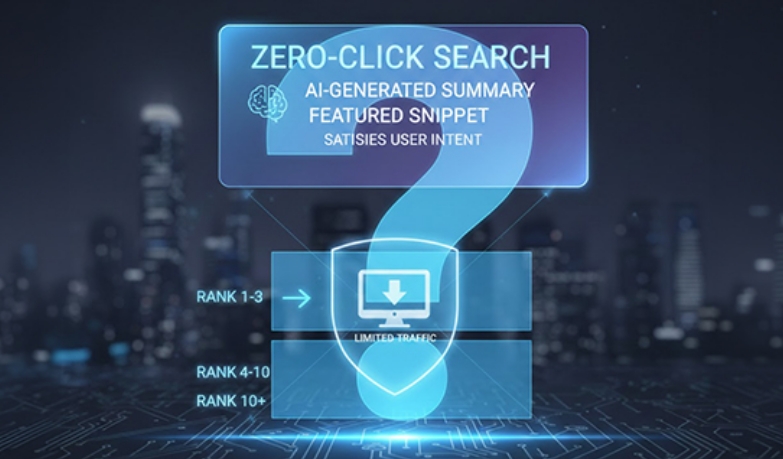
Historically, ranking position correlated strongly with traffic volume. Higher rankings produced more clicks. In the current environment, this relationship is weakening.
A page may rank in the top three results but still receive limited traffic if a featured snippet or AI-generated summary satisfies the user’s intent above the organic listings.
This means rankings alone are no longer sufficient indicators of search success. Businesses must evaluate:
- Whether their content appears in answer modules
- Whether their brand is cited or referenced
- Whether their explanations are being used to construct summaries
Visibility is becoming multi-layered rather than linear.
The Business Risk of Ignoring Zero-Click Search
The most obvious risk is declining organic traffic. However, a more serious long-term risk is declining influence. When users repeatedly encounter answers that originate from other brands, those brands gradually become associated with expertise in that subject area. Over time, this shapes perception, preference, and trust. Companies that do not appear within these answer environments may remain technically present in search results but absent from the user’s learning process.
This affects:
- Brand authority
- Thought leadership perception
- Early-stage buyer education
- Consideration-set inclusion
Traffic loss is measurable. Influence loss is slower and harder to detect, but often more damaging.
How Content Must Be Structured for Zero-Click Environments
Content that performs well in zero-click contexts typically follows a predictable structure.
Each major section should:
- Address a specific user question
- Provide a direct answer near the top of the section
- Expand with explanation and examples
- Maintain consistent terminology
Visibility is becoming multi-layered rather than linear.
This approach benefits both users and search systems. For example, instead of a heading such as “The Future of SEO,” a more functional heading would be “How Zero-Click Search Affects SEO Performance.” The section would then begin with a clear explanation of the impact. This does not mean simplifying content. It means organising it so that the main point is immediately accessible.

The Role of Topical Authority
Search engines increasingly evaluate content at the domain and brand level, not only at the page level. A website that consistently publishes detailed, accurate, and well-structured content across a topic cluster is more likely to be treated as a reliable source.
Topical authority is built through:
- Comprehensive coverage of subtopics
- Internal linking between related pages
- Consistent terminology and definitions
- Demonstrated subject matter depth
One-off articles rarely establish authority. Authority develops through sustained, coherent coverage. In zero-click environments, authority strongly influences which sources are selected for answers.
Measuring Visibility Beyond Traffic
Businesses must expand their performance measurement frameworks.
In addition to sessions and clicks, organizations should monitor:
- Featured snippet ownership
- Appearances in People Also Ask results
- Brand mentions within AI summaries
- Impressions for informational queries
These indicators show whether the brand is participating in the user’s information journey, even when no click occurs. This broader measurement approach supports more accurate strategic decisions.
How Content Planning Must Change
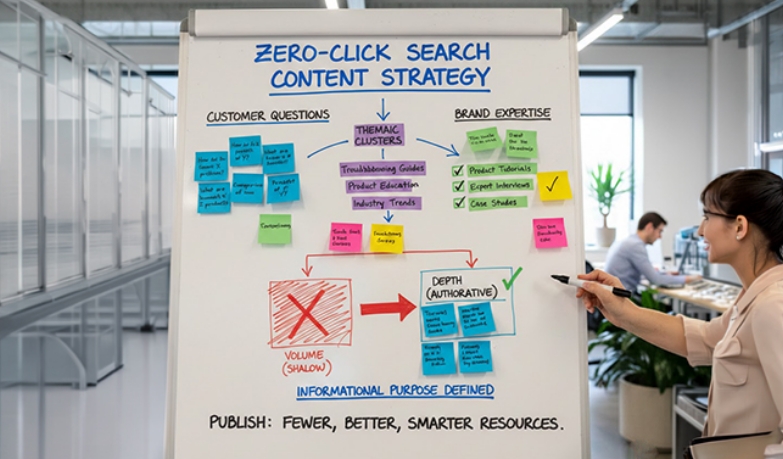
Content planning should begin with mapping user questions rather than brainstorming article titles
This involves:
- Identifying common customer questions
- Grouping questions into thematic clusters
- Determining which questions align with brand expertise
- Prioritizing depth over volume
Each piece of content should have a defined informational purpose. Publishing fewer but better-structured and more authoritative resources is often more effective than publishing large volumes of shallow content.
The Role of Professional Content Strategy Partners
Adapting to zero-click search requires coordination between SEO specialists, content strategists, subject matter experts, and technical teams. Organizations often struggle because their workflows treat SEO, content, and branding as separate functions.
Doodlezz approaches modern search visibility as an integrated discipline. The focus is on aligning brand expertise, search behaviour, and content structure so that information produced by the brand is usable by both humans and search systems.
This includes:
- Topical authority mapping
- Search intent analysis
- Content architecture design
- Ongoing optimization based on visibility signals
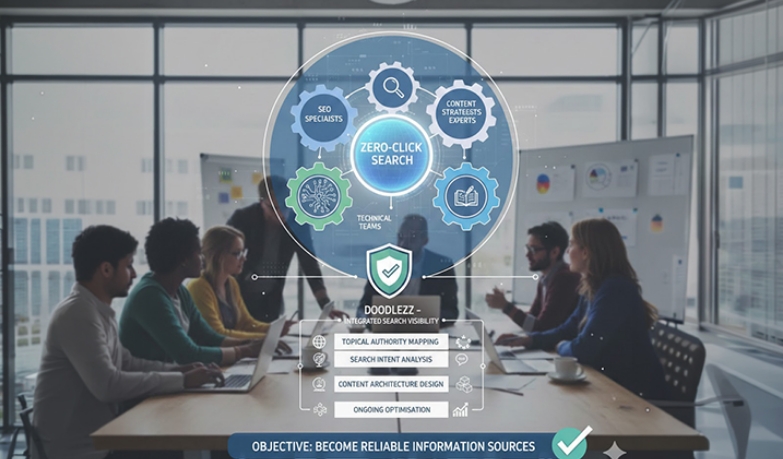
The objective is to help brands become reliable information sources within their domains.
Conclusion
The zero-click era reflects a fundamental change in how information is delivered through search platforms. Users increasingly receive answers directly, and search engines increasingly select sources based on authority, clarity, and structure. Businesses that continue to rely solely on traditional ranking-based SEO models risk losing visibility in subtle but significant ways.
Adapting does not require abandoning SEO. It requires expanding it. Organizations must design content to serve as extractable, trustworthy answers while maintaining depth and credibility. Companies that make this transition position themselves to remain visible, relevant, and influential as search continues to evolve.

Krishna Talreja
Tech - Content writer
Apr 24, 2026
Why Doodlezz?

We are an integrated marketing partner that combines creative strategy with operational delivery, identity, guidelines, packaging, assets, and content built for both digital commerce and offline retail. Unlike boutique creative studios that stop at concepts, Doodlezz takes designs through production, vendor liaison, and campaign ready packaging, reducing launch friction. In the Oman India market, agencies often specialise in either creative or execution; Doodlezz’s end to end model positions it to reduce vendor hand-offs and accelerate time to market. Build a Brand System that Performs